



What to have in your car when driving abroad and what to watch out for
Travelling abroad by car gives you enormous freedom, especially if you choose a reliable vehicle from a car rental company for your trip. But if you do not want your dream holiday to become more expensive because of fines worth hundreds or even thousands of euros, you need to be prepared for one simple fact: Europe does not have one unified set of rules. What is enough for the Czech police may be considered a serious offence abroad.
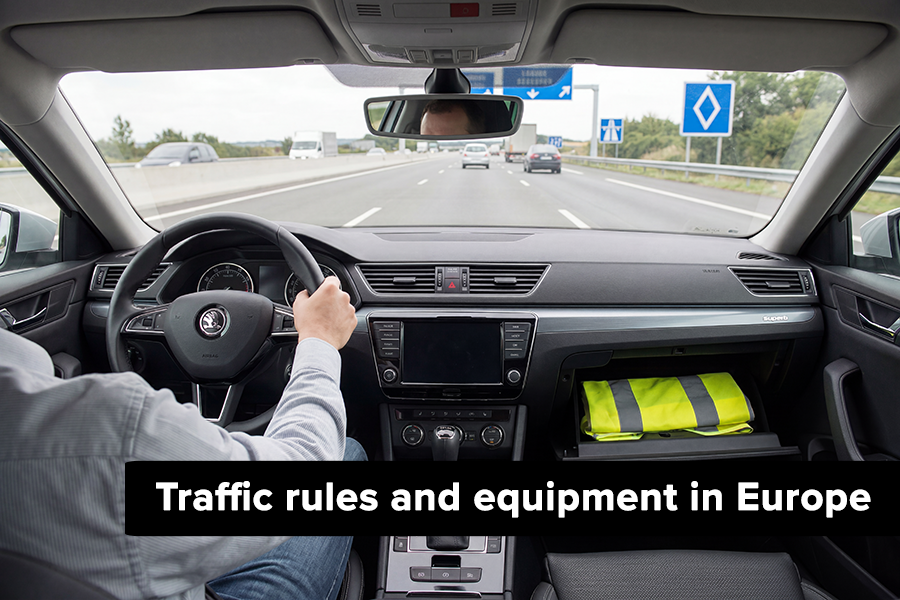
The Vienna convention theoretically says that the police should tolerate the mandatory equipment required in the country where the vehicle is registered, in this case the Czech Republic. In reality, however, roadside checks can be different. Local authorities often refer to their own national rules, especially those that regulate the behaviour of the crew, such as the obligation to wear a reflective vest when getting out of the car. The golden rule for a calm journey is therefore simple: it is always safer to follow the legislation of the country you are driving through.
Specific mandatory equipment and traffic rules in Europe
Before we look at the detailed rules for specific destinations, remember that the foundation of a successful trip is your own preparation. Below, you will find an overview of the European countries where customers most often travel with Taggart cars. For each country, we have summarised the most important differences in mandatory equipment, speed limits and hidden traps that could surprise you on the road.
Slovakia
With our eastern neighbours, the speed limits are 50 km/h in built-up areas, 90 km/h outside built-up areas and 130 km/h on motorways. Reflective vests are mandatory for all passengers who get out of the vehicle in an emergency.
Pay close attention to the windscreen. Navigation devices, dashcams and phone holders must not be placed in the driver’s field of vision, otherwise you risk a fine.
Germany
In Germany, the speed limit is 50 km/h in built-up areas, 100 km/h outside built-up areas and, on motorways, the well-known recommended speed is 130 km/h unless road signs state otherwise. A reflective vest is mandatory for the driver and strongly recommended for the rest of the crew.
A specific feature of Germany is so-called situational winter equipment. This means that if it snows or the roads are icy in winter, you must have winter tyres regardless of the date. To enter the centres of many German cities, you also need an environmental sticker.
Austria
Austria is known for strict checks. The speed limits are 50 km/h in built-up areas, 100 km/h outside built-up areas and 130 km/h on motorways. All passengers must have reflective vests, and it is better to take orange certified vests to Austria, as the police tend to prefer them over other colours.
Dashcams are an absolute taboo here. Recording traffic is strictly penalised due to privacy protection, and fines can reach extremely high amounts.
Apart from classic speeding, Czech drivers most often receive fines on Austrian motorways in sections marked with the abbreviation IG-L, which stands for Immissionsschutzgesetz-Luft. These are air protection zones where the speed limit is electronically reduced, usually to 100 km/h.
If you drive faster in these sections, you will not receive a standard speeding fine, but an environmental fine for air pollution. This starts at EUR 150 and can increase to several thousand euros. The exemption only applies to electric vehicles with a special Czech “EL” registration plate, which must also meet Austrian conditions for the exemption.
Poland
In Poland, the speed limits are 50 km/h in built-up areas, 90 km/h outside built-up areas, 120 km/h on expressways and 140 km/h on motorways. You must use a reflective vest when getting out of the car outside built-up areas in reduced visibility or at night.
Polish rules also require a fire extinguisher. Even though exemptions apply to foreign vehicles, Polish police like to check for it, so it is better to have one in the car.
France
French roads have speed limits of 50 km/h in built-up areas, 80 to 90 km/h outside built-up areas, depending on the decision of the specific region, and 130 km/h on motorways. A French speciality is the reduction of speed in rain. On a motorway, for example, you must slow down to 110 km/h in rainy conditions.
Reflective vests are mandatory for the entire crew and should be within easy reach in the car. A breathalyser is officially recommended in the vehicle. Although the fine for not having one has been abolished, police officers still like to see it during checks.
However, you need to watch out for special traffic lanes, which France has been expanding massively in recent years. You will find them on motorway approaches and urban ring roads around Paris, Lyon, Grenoble, Strasbourg, Lille and Rennes.
You can recognise them by a lit or painted white diamond, known as a losange blanc, on a black or blue background, usually in the left lane. Entry into this lane is only allowed for cars carrying at least 2 people, including a child in a child seat. Taxis, buses and electric vehicles with a special Crit’Air 0 eco-sticker are also allowed to use them.
The big trap is that these lanes are often dynamic. For example, they may apply only during the morning and afternoon rush hour on working days. When the diamond is lit, the lane is reserved. When the sign is off, everyone may use it. Compliance is monitored by special AI-powered cameras that scan the vehicle crew, including the front and rear seats, and automatically issue a EUR 135 fine for solo driving in the lane.
Italy
In Italy, follow speed limits of 50 km/h in built-up areas, 90 km/h outside built-up areas and 130 km/h on motorways. Reflective vests are mandatory for everyone in the car during an emergency stop.
The biggest fear for tourists is the so-called ZTL zones, meaning Zona a traffico limitato. These are historic city centres where entry is permitted only for residents. Entrances are monitored by cameras, and fines for unauthorised entry are issued automatically, often several months later.
Slovenia
Slovenia requires speed limits of 50 km/h in built-up areas, 90 km/h outside built-up areas and 130 km/h on motorways. Reflective vests are mandatory for the entire crew of the car. Slovenian police strictly punish any use of radar detectors or anti-radar devices. For vehicles with older types of headlights, they also still require a set of spare bulbs.
Croatia
On the way to the seaside in Croatia, expect speed limits of 50 km/h in built-up areas, 90 km/h outside built-up areas and 130 km/h on motorways. A reflective vest is mandatory for the driver and recommended for other passengers. However, Croatia has one important specific rule for young drivers.
Today, this is no longer about reduced speed limits, as it used to be, but about zero alcohol tolerance behind the wheel. You must have zero alcohol if you are under 24 years old or have held your driving licence for less than two years.
Spain
Spanish rules set speed limits at 50 km/h in built-up areas, 90 km/h outside built-up areas and 120 km/h on motorways. If you wear prescription glasses, Spanish law directly requires you to have one spare pair in the car. Reflective vests are mandatory for everyone who gets out of the vehicle onto the road. Interestingly, Spain requires two warning triangles, or alternatively an approved modern V-16 electronic beacon placed on the roof of the car.
Similarly to France, Spain is introducing special traffic lanes. These reserved sections are called BUS-VAO lanes, from Vehículos de alta ocupación. You will mainly encounter them on major motorway routes leading into the centres of large cities such as Madrid, Barcelona and Granada.
The sign shows a bus and car symbol with wording that defines the minimum number of occupants, most often VAO-2, meaning 2 or more people, or VAO-3, meaning 3 or more people in the car. If you do not meet this requirement, you must stay in the regular lane, otherwise you risk a fine of around EUR 200. Exceptions again apply to motorcycles, disabled drivers and vehicles with an “Eco” or “Zero” environmental label.
Switzerland
In Alpine Switzerland, the speed limits are 50 km/h in built-up areas, 80 km/h outside built-up areas and 120 km/h on motorways. The only mandatory equipment is a warning triangle, but it must not be buried deep in the boot. It must be within the driver’s reach. Switzerland is known for extremely high fines, and more serious speeding is classified as a criminal offence. The amount of the fine is often based on your annual income.
What to watch out for when travelling with a rental car
If you are going on holiday with a car from Taggart car rental, you can forget most worries about mandatory equipment. Our cars are fully and professionally equipped for trouble-free operation in the Czech Republic and abroad. Nevertheless, before your trip, you still need to remember two important legal documents.
The first is a vehicle rental confirmation, internationally referred to as VEIKEL. During a random roadside check in European Union countries or when crossing borders outside the Schengen area, you must prove to the police that the car is not stolen and that you have the right to use it.
This is done with written consent from the vehicle owner, meaning the car rental company, allowing the vehicle to be taken abroad. The document is issued in English or German. At Taggart, we will prepare this document for your rental — just tell us that you plan to travel abroad.
Especially when travelling abroad, rent a car from a verified rental company that will support you if something unexpected happens. You can also choose based on customer reviews. Taggart, for example, has an excellent rating of 4.9/5, as you can see for yourself below.
The second document is the green card, which serves as international proof of motor third-party liability insurance. Although you no longer need to carry a physical green card in the Czech Republic, abroad you must still be able to present it, either in printed form or digitally on your phone within the EU. Our vehicles have insurance valid throughout the EU, but before your trip, always visually check whether any countries are crossed out on the card.
Where can you drive and where is entry prohibited?
With our vehicles, you can safely travel to the vast majority of EU countries. You can also travel to the United Kingdom without any problems. In that case, just remember to drive on the left and make sure your headlights are correctly adjusted so you do not dazzle oncoming drivers at night.
You are also free to visit luxurious Monaco on the French Riviera. Here, we only recommend extra caution in narrow streets and strict compliance with parking rules, which local police enforce very strictly.
However, there are destinations where you cannot take our vehicles. For strict insurance and safety reasons, there is a strict ban on entry into Romania, Bulgaria and Greece. In these specific countries, the car rental company’s insurance is not valid.
Calculate how much renting your selected car for your holiday would cost.
What should you remember?
Before you turn the key in the ignition and set off, check three basic things. Make sure you have enough reflective vests for all crew members in the cabin of the vehicle, meaning within easy reach. Check that your documents include the written vehicle rental confirmation in a foreign language issued by us. And finally, make sure your route does not lead to prohibited countries, meaning Romania, Bulgaria or Greece.
If everything is ready, all that remains is to set the navigation and enjoy a safe and comfortable journey.